If you run or work in a CA practice, you have probably had some version of this conversation already. A partner has seen a demo. An article assistant is quietly using a chatbot on client files. Nobody can say what the firm's actual position is. AI for chartered accountants in India is a workflow and controls question before it is a software question: which work goes first, what client data the tool may see, who reviews the output, and how the file shows it.
I write as Pratik Bajoria, Chartered Accountant, ex-Big 4, and founder of Findost. The lens is practical: structured workflows, measurable controls, and YMYL caution. Nothing here invents client metrics or promises regulatory outcomes. Use it as an implementation map, then verify tools and policies against your own practice.
What “AI for CA firms India” should mean in 2026
Three jobs dominate early value: faster first drafts of analysis and memos under review; document extraction into structured working papers; and exception-led reconciliation or compliance checklists. Prediction theatre and unsupervised client advice are late-stage ideas — if they belong at all. The firms that climb search and win trust will publish and operate with that sequencing, not with hype.
The scale is worth stating plainly. ICAI describes itself as the world’s largest professional accountancy body, with over 15 lakh members and students (February 2026), so small changes in how practices handle routine work add up across the profession. Adoption itself is no longer the question. McKinsey’s 2026 global survey found that nearly nine in ten respondents report regular AI use in at least one business function, yet only 37% attribute any EBIT impact to it. In practice, what I see in CA firms mirrors that gap: plenty of individual use, very little of it designed.
Everything below follows that sequencing. It is a map, not a catalogue: a readiness rubric you can score honestly, a five-step implementation order, and links to the deeper playbooks on GST reconciliation, audit working papers, tooling, pilots and build-versus-buy.
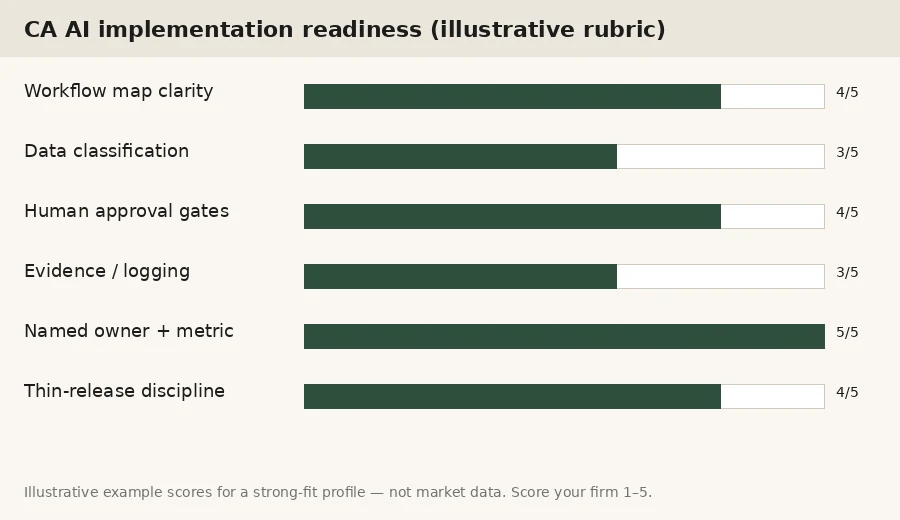
| Axis | 1 = weak fit | 5 = strong fit | Your score |
|---|---|---|---|
| Workflow clarity | Tribal knowledge only | Five-line map exists for priority jobs | ___ |
| Controls | Outputs go straight to clients/books | Human gate + logging defined | ___ |
| Data | Anything pasted into consumer tools | Classes + approved environments | ___ |
| Metrics | No baseline | Named metric reviewed weekly | ___ |
| Scope | Transformation programme | One thin release funded | ___ |
By the numbers
The numbers that frame AI work in Indian practice. Each links to its official source and date.
15 lakh+
members and students of ICAI, the world’s largest professional accountancy body, with 185 branches in India.
Source: ICAI, February 2026
₹22.27 lakh crore
approximate gross GST collection in 2025-26, up from about ₹13.76 lakh crore in 2021-22.
Source: PIB, 30 June 2026
59%
of finance leaders report using AI in their finance function (183 CFOs and senior finance leaders surveyed, May–June 2025), against 37% in 2023.
Source: Gartner, 18 November 2025
10 principles
in NFRA’s first staff paper on technology in audit: tools may help, but responsibility for the opinion stays with the auditor.
Source: NFRA, 23 July 2026
60 days · 7 years
to assemble the final audit file after the report date (ordinarily), and the minimum retention period, under SA 230 and SQC 1.
Source: ICAI, SA 230
A CA-led implementation sequence
1. Map five recurring jobs. Research and first-draft analysis, document extraction, reconciliation and exceptions, management or client reporting, and routine communication. For each, write input, decision, output, owner and definition of good. Blank lines mean you are not ready to buy.
2. Classify data. Client identity, unpublished financials, and advice drafts are restricted by default. Consumer chatbots are not an approved environment for restricted classes. Approved tools need access control, retention clarity and exportable logs.
3. Design human gates before automation. Decide what a person must approve before something becomes a deliverable, a filing support pack or a ledger-adjacent entry. An unauditable answer is not a professional deliverable.
4. Fund one thin release. One workflow, one team, one metric, two to four weeks, stop conditions in writing. Review weekly. Document the pattern if it works; stop if it does not.
5. Only then expand tooling. Read the deeper guides on best AI tools for chartered accountants and finance professionals, why corporate AI pilots stall, and build vs buy for AI tooling. Tool lists without gates are shopping lists.
Where Indian CA practices should be careful
Professional work sits in YMYL territory. Do not let keyword pressure push unverifiable claims onto your site or into client memos. Keep ICAI and firm quality standards in view; AI does not replace the signing professional. For securities-market adjacent work, treat SEBI’s public materials as part of your compliance reading list — not as a substitute for counsel. Prefer primary sources when you cite regulation.
Two dates belong on every partner's calendar. The Digital Personal Data Protection Rules, 2025 were notified in November 2025 with an 18-month phased compliance timeline, so client personal data inside AI workflows is a live compliance matter, not a future one. And busy season has moved: for AY 2026-27 the CBDT has extended the specified date for tax audit reports from 30 September to 21 October 2026. A pilot you start this month will run straight through that peak, so design it to survive it.
Internal links worth keeping open while you plan: the free AI Opportunity Scorecard, the scoped AI Opportunity Audit, and discovery via a conversation on measurable P&L use cases.
How CA firms in India usually waste the first six months
The pattern is familiar. A partner sees a demo. An associate is told to “try ChatGPT on research”. Someone buys three overlapping licences. Nobody names the metric. Busy season arrives and the experiment dies. Six months later the firm concludes “AI does not work for us”, when what failed was the operating design.
Another failure mode is treating AI as a marketing slogan for the practice website while the delivery system stays unchanged. That may win a few enquiries; it will not survive peer review or a difficult client file. Cite-worthy implementation content — and cite-worthy delivery — both require the same discipline: narrow scope, evidence, named owners.
A third failure mode is copying Silicon Valley tooling narratives into Indian practice economics. Staffing mixes, software stacks, GST and MCA filing calendars, and client confidentiality expectations differ. Import frameworks; do not import fantasy ROI slides. Budget for review time and exception handling on the same sheet as licences.
What “good” looks like after ninety days
You should be able to show one completed thin release with: a five-line workflow map, a baseline sketch, a dual ownership record, an exception log, and a weekly metric review note. You should also be able to say what you declined — which pilots you refused because the gate or metric was missing. That refusal list is as important as the success story.
From there, expand only along the five-job map. Keep a shared register of AI-assisted workflows. Link each live item to evidence locations. Revisit build-versus-buy when volume or data sensitivity changes. Do not expand because a vendor quarter-end discount appeared.
Partners should also agree four one-page rules once at firm level: ownership, data classes, human gates, logging. Then let each service line fund its own thin release inside those rules. Central theatre committees without P&L ownership rarely ship.
Measuring finance AI ROI before you scale
Once a thin release exists, partners and CFOs still need a shared definition of return. Baseline one workflow, put review time on the cost side, and score candidates on value, feasibility, control risk and measurement clarity before claiming payback. I have set out that decision rubric in Finance AI ROI for Mid-Market Companies in India: A CA's Decision Rubric.
Operating cadence that survives busy season
AI that only works in a quiet week will die in filings season. Bake the thin release into the Monday checklist: owner, metric, exception path, data the tool may see, weekly review. Use a workspace for the register and evidence links; keep the books in the books. If a pilot cannot explain itself in five minutes on Monday, it is not ready.
For multi-office practices, start with one office and one service line. Publish the pattern internally before you franchise it. The second deployment should be cheaper than the first because the evidence trail already exists — not because you bought a larger platform licence.
How to brief your partnership without a forty-page deck
One page is enough. State the five-job map, the four rules, the single thin release you will fund, the metric, the stop conditions, and the review date. Attach the readiness rubric with your own scores — not illustrative bars from a vendor PDF. If partners cannot agree that page in one meeting, you are not ready to buy software.
Then publish the same page internally so associates know what “good” looks like before busy season. Clarity beats enthusiasm. Enthusiasm without gates becomes another zombie licence.
Deeper CA playbooks: GST and audit
Two workflows come up in almost every CA practice conversation. For monthly GST work, read how Indian CA firms can use AI for GST reconciliation without risking client data — GSTR-2B matching, IMS review and notice triage with a clear human gate. For assurance work, read AI for audit working papers in India: what to automate and what must stay human — how to use AI without weakening SA 230 documentation. If you run or staff a company’s internal audit under section 138, read AI for internal audit in Indian companies: a practical starting point — full-population testing of one process and what ICAI’s new SIA 240 on tools expects. For the operating habit that keeps both alive in busy season, see the Monday morning test for any AI workflow. For the companies audit report itself, AI for CARO 2020 reporting: where it helps and where judgement stays goes clause by clause through what a tool can prepare and what the auditor decides.
Choosing the assistant itself: ChatGPT, Copilot or Gemini
Once the rules are agreed, partners usually ask which assistant to license. My view is that the deciding factors are where client files already live, how clean folder permissions are, and what the vendor’s business terms say about training, retention and logs, not which demo looked best. I have set out a partner-ready rubric in ChatGPT, Copilot or Gemini? How a CA firm in India should choose an AI assistant, alongside the AI controls checklist for CA firms that applies whichever tool you pick.
Client personal data under the DPDP Act
Before any assistant touches salary registers, KYC or individual tax files, decide whether the firm is acting as Data Fiduciary or Data Processor on that engagement, read the vendor’s data terms, and put masking, firm-managed accounts, logs and breach escalation in place. Most operational obligations in the DPDP Rules, 2025 commence in May 2027. I have set out an eight-axis scoring rubric and a Monday checklist in DPDP Act and AI in CA Firms in India: A Client-Data Decision Rubric.
Transaction work: AI in financial due diligence
Due diligence is where firms most often ask whether AI can read a data room. It can index documents, scan ledgers and extract contract clauses, but quality-of-earnings adjustments, net debt and tax exposures stay with the CA, and NDAs and SEBI’s insider trading rules on UPSI come before any upload. I have set out a workstream-by-workstream rubric and a Monday checklist in AI for Financial Due Diligence in India: A CA’s Decision Rubric.
Running the first pilot: a 30/60/90-day playbook
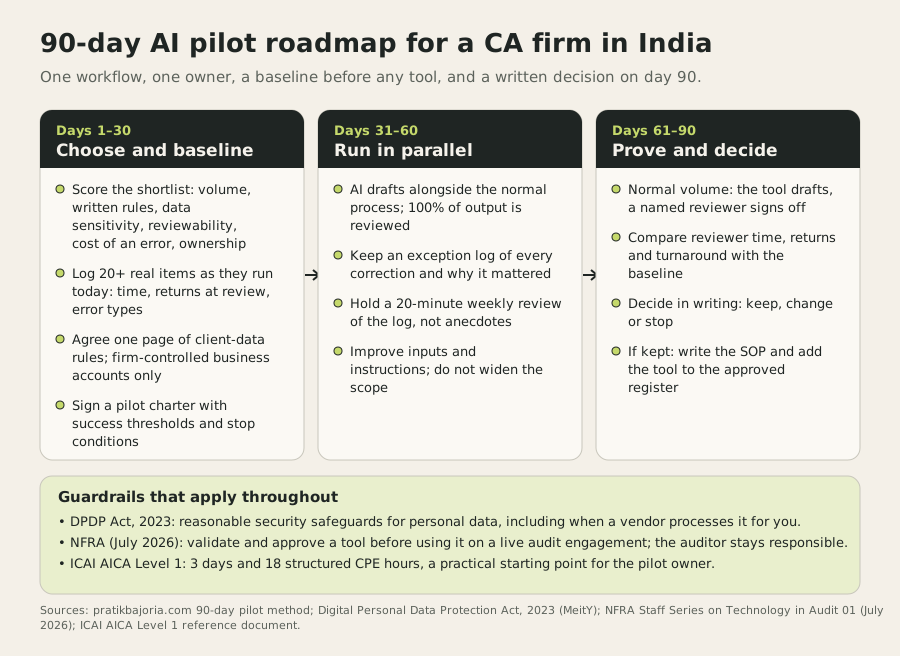
Text version of this infographic
- Days 1–30, choose and baseline: score the shortlist on volume, written rules, data sensitivity, reviewability, cost of an error and ownership; log at least 20 real items as they run today; agree one page of client-data rules using firm-controlled business accounts only; sign a pilot charter with success thresholds and stop conditions.
- Days 31–60, run in parallel: AI drafts alongside the normal process and 100% of output is reviewed; keep an exception log; hold a 20-minute weekly review of the log; improve inputs and instructions without widening scope.
- Days 61–90, prove and decide: run at normal volume with a named reviewer signing off; compare reviewer time, returns and turnaround with the baseline; decide in writing to keep, change or stop; if kept, write the SOP and add the tool to the approved register.
- Guardrails: the DPDP Act, 2023 requires reasonable security safeguards for personal data, including when a vendor processes it; NFRA’s July 2026 paper expects tools to be validated and approved before use on a live audit engagement; ICAI’s AICA Level 1 is 3 days and 18 structured CPE hours.
Agreeing the rules and picking the assistant are the start, not the result. The first real test is one workflow, run for ninety days, with a baseline taken before anyone opens the tool, full human review while it runs in parallel, and a written go, adjust or stop decision at the end. I have set out the month-by-month version, with a workflow selection scorecard and a go/no-go gate, in how to run a 90-day AI pilot in a CA firm in India.
The questions partners, CAs and students keep asking
Four questions come up in almost every conversation I have with the profession, so I have answered each one properly, with sources: will AI replace chartered accountants in India; how audit and accounting firms in India are using AI, from Big 4 platforms to ICAI’s own tools; which AI courses for chartered accountants are worth it, including ICAI’s AICA levels; and, for students, whether CA is worth it in 2026 with AI. If you run a practice, the training question is just as pressing: I have set out a two-year plan in AI and articleship: how CA firms should train article assistants now.
Every guide in this hub
Use this as the index. The first list covers running a CA practice with AI; the second goes workflow by workflow through tax, audit and GST.
Running a CA practice with AI
- DPDP Act and AI in CA Firms in India: A Client-Data Decision Rubric
- How CA Firms in India Should Price Work When AI Cuts the Hours
- How to Run a 90-Day AI Pilot in a CA Firm in India: A 30/60/90 Playbook
- ChatGPT, Copilot or Gemini? How a CA Firm in India Should Choose an AI Assistant
- AI Controls Checklist for CA Firms in India: Practical Review Gates
- Will AI Replace Chartered Accountants in India? A CA’s Honest Answer
- How Audit and Accounting Firms in India Are Using AI in 2026
- AI Courses for Chartered Accountants in India: What Is Actually Worth It
- Is CA Worth It in 2026 With AI? A Chartered Accountant’s View
- AI for Chartered Accountants: Practical Use Cases and Control Gates
- Best AI Tools for Chartered Accountants and Finance Professionals
- A Chartered Accountant's AI Toolkit for Entrepreneurs
- Notion for Finance Professionals: Templates, Dashboards, and Workflows
Tax, audit and GST workflows
- AI for Financial Due Diligence in India: A CA’s Decision Rubric
- How Indian CA Firms Can Use AI for GST Reconciliation Without Risking Client Data
- Drafting Replies to GST and Income Tax Notices With AI Without Losing Control
- Using AI for TDS Reconciliation in Indian CA Firms: From 26AS to Form 168
- AI for Tax Audit in India: Form 3CD This Year, Form 26 Next Year
- AI for Audit Working Papers in India: What a CA Should Automate and What Must Stay Human
- AI for CARO 2020 Reporting: Where It Helps and Where Judgement Stays
- AI and Articleship: How CA Firms Should Train Article Assistants Now
- AI for Internal Audit in Indian Companies: A Practical Starting Point
If you advise finance teams rather than run a practice, read AI implementation for finance teams. For operations, sales and customer workflows, see AI automation in India.
Monday-morning checklist
- Pick one job from the five-job map and write the five-line workflow.
- Classify data and block restricted classes from consumer tools.
- Name dual owners and the weekly metric before buying licences.
- Ship a thin release with stop conditions; review weekly.
- Read tooling, pilots and build-vs-buy guides before expanding scope.
- Keep a written list of pilots you declined and why.
Frequently asked questions
What is the best starting point for AI in a CA firm?
Start with a repetitive workflow where the input, output, owner and definition of good are clear. Research drafts, document extraction, reconciliation exceptions and reporting support are usually easier to test than unsupervised client advice.
How should a CA firm protect client data when using AI?
Classify the data first, use approved business accounts, define retention and access rules, redact where required and keep sensitive material out of unapproved consumer tools. The firm should document the decision and review vendor terms.
What controls should be in place before scaling an AI pilot?
Use a named owner, human review gate, test set with awkward cases, exception log, evidence trail and a clear incident path. Scale only when the process is measurably better without unacceptable control degradation.
Sources
- NIST AI Risk Management Framework
- SEBI — investor / regulatory portal
- ICAI — Institute of Chartered Accountants of India
- ICAI — press release on the 2025-26 Council (over 4 lakh members, around 9.85 lakh students)
- McKinsey — The state of AI: global survey 2025
- PIB — Government notifies DPDP Rules (14 November 2025)
- PIB — CBDT extends AY 2026-27 due dates for audited taxpayers (29 September 2026)
- ICAI — About ICAI, with membership and network figures (February 2026)
- PIB — Nine Years of GST (30 June 2026)
- Gartner — Finance AI adoption remains steady in 2025 (18 November 2025)
- NFRA — Staff Series on Technology in Audit: General Principles (23 July 2026)
Educational commentary for CA and finance leaders in India — not personalised professional, tax, legal or investment advice. Confirm tools, privacy terms and firm policies before deployment.