The build-versus-buy decision for AI tooling should follow differentiation, data sensitivity, time to value and switching cost — not fashion or vendor pressure. Leaders who start with a model demo and work backwards into a business case often discover the hard costs late: integration debt, unowned change management and a renew button that is harder to press than to cancel.
Start with the workflow and the economics. Which process has enough volume, friction and measurable output to justify a controlled intervention? A strong candidate has a defined input, a repeatable transformation or decision, and an owner who can describe what good looks like today. Only after that map is clear should you choose between licensing a vendor product, assembling managed services and APIs, or building a custom capability.
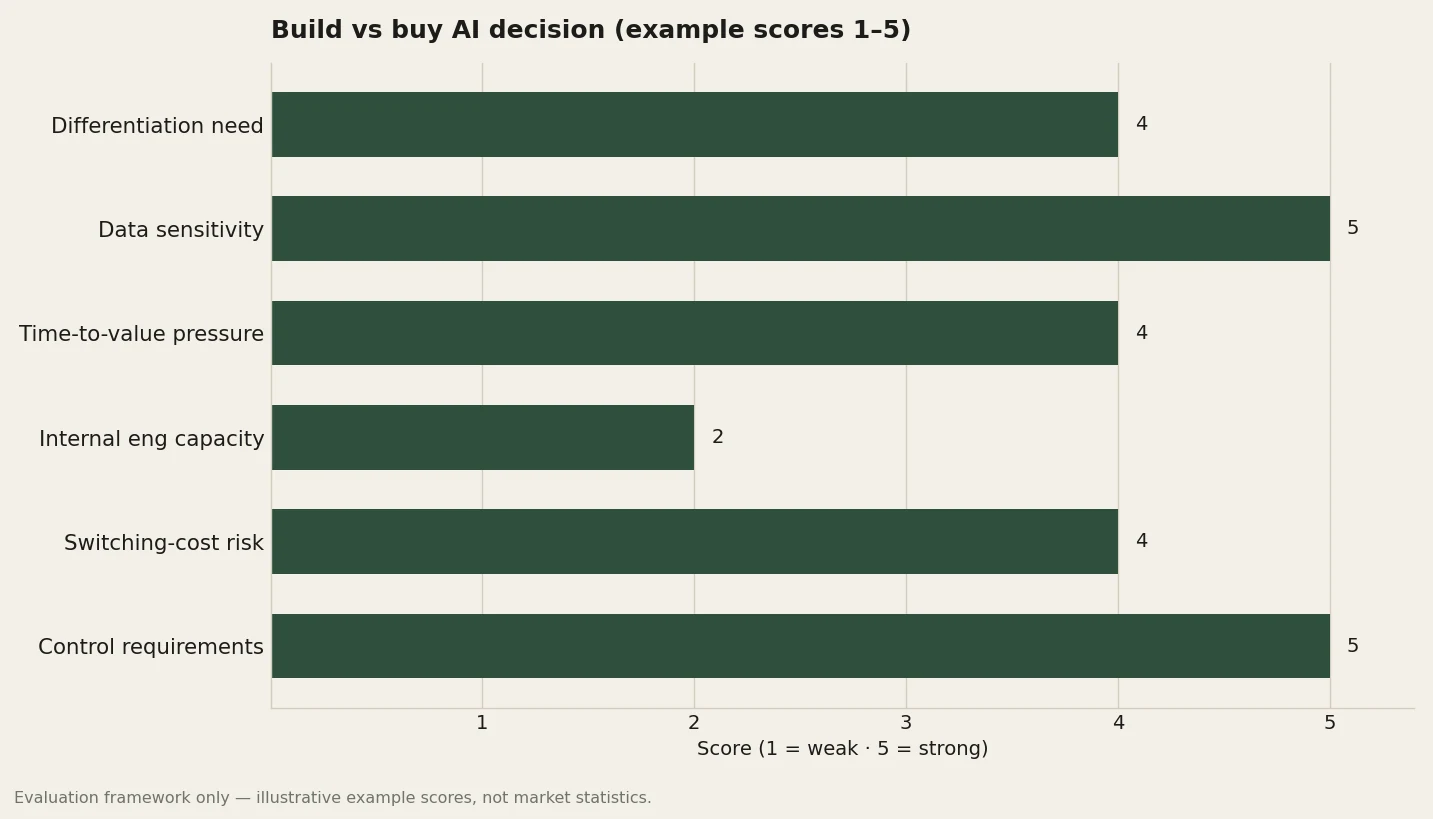
Decision rubric (score 1–5 yourself)
Score each row before funding a custom build. High differentiation, high sensitivity and strong engineering capacity tilt toward build or tightly controlled assembly. High time pressure, low differentiation and weak maintenance capacity tilt toward buy — with exit clauses and data portability checked in advance.
| Axis | 1 = weak fit | 5 = strong fit | Your score |
|---|---|---|---|
| Differentiation need | Commodity workflow | Capability is a competitive edge | ___ |
| Data sensitivity | Low-sensitivity public data | Sensitive finance or customer data | ___ |
| Time-to-value pressure | Months available to experiment | Need operating value within weeks | ___ |
| Internal eng capacity | No capacity to maintain systems | Team can own build and operations | ___ |
| Switching-cost risk | Easy to exit vendor | Lock-in would be painful later | ___ |
| Control requirements | Light logging sufficient | Audit trail and policy controls required | ___ |
When buying is usually the rational first move
Buy when the workflow is common across industries, when a vendor already encodes controls you would otherwise reinvent, and when time-to-value matters more than unique model behaviour. Finance close assistants, CRM copilots, research workspaces and document classification often fall here. Buying still requires an owner, a success metric, an exception policy and a four-week falsifiable pilot. A licence without an operating rhythm is just another dashboard.
Check data processing terms, retention, exportability and admin controls before you paste production data into a trial. Confirm who can enable integrations and who can revoke them. Write the kill criteria on day one: what metric must move, and what evidence would cause you to cancel without embarrassment.
When building (or assembling) can be justified
Build or assemble when the workflow is truly differentiating, when data cannot leave your boundary under current policy, or when vendor roadmaps cannot meet control requirements you must evidence to auditors, lenders or boards. Building means more than a prompt: it means data pipelines, evaluation sets, access control, logging, incident response and a named engineering owner after the project team moves on.
Hidden costs include evaluation datasets that nobody maintains, prompt or rules drift, integration breakage when upstream systems change, and the opportunity cost of engineers not shipping customer-facing work. If you cannot fund those costs for twelve months, you are not buying a build — you are buying a future outage.
Monday-morning checklist
- Write the workflow map: inputs, decisions that stay human, outputs, success metric.
- Score the rubric and decide buy / assemble / build in one sentence with an owner.
- List data classes allowed in the pilot and the approval required to expand them.
- Define four-week stop conditions and the artefacts the review must produce.
- Schedule the renew/kill meeting before the pilot starts — not after the invoice arrives.
Switching costs and hybrid patterns
Many mid-market teams land on a hybrid: buy the commodity layer, build the thin differentiation, and keep a clean interface between them. That only works if exports, APIs and ownership boundaries are designed early. Otherwise the “temporary” vendor becomes a permanent dependency with rising seats and unclear accountability.
Treat switching cost as a first-class design constraint. Ask how you would export prompts, evaluation sets, documents and telemetry. Ask how long it would take to retrain staff. Ask what breaks if the vendor changes pricing or deprecates a feature. Those answers belong in the business case alongside licence fees.
What this framework is not
This is educational content, not a procurement recommendation for any specific vendor. Confirm security questionnaires, contracts and data terms with your advisors before committing.
How to review progress after four weeks
At the end of a controlled trial, write a one-page note a sceptical finance partner can read. Cover what you attempted, what evidence you produced, what changed in operating behaviour, and whether the tool or workflow should be renewed, narrowed or cancelled. Prefer concrete artefacts — decision logs, exception lists, shipped actions — over vanity dashboards. If you cannot produce that note, the experiment is incomplete regardless of how impressive demos looked.
Carry forward only the workflows with a named owner and a metric you already manage. Archive unused seats, unused templates and unused tracking lists. Tool sprawl is a quiet tax on attention; a shorter stack with weekly discipline usually beats a broad stack that nobody operates. Put the renew/kill decision on the calendar so it is not postponed by another shiny pilot.
If the note shows partial value, narrow scope rather than expanding seats. Keep the one workflow that moved a metric, document the SOP, and pause everything else. Partial success is still success when it becomes an operating habit instead of a slide in a quarterly update.
What changes the answer for finance teams in India
The generic framework above holds, but three Indian specifics push finance teams and CA firms towards buying or assembling, and away from bespoke builds, more often than founders expect.
Personal data obligations travel with the tool. The DPDP Act, 2023 and the DPDP Rules, 2025 apply whether you build or buy. Building does not remove the obligation; it moves the whole burden of security, retention and deletion onto your team. Buying lets you push part of it into a contract you can check.
The books need an audit trail. Companies using accounting software must use software with a non-disableable edit log for financial years from 1 April 2023 (proviso to Rule 3(1), Companies (Accounts) Rules, 2014; see the ICAI implementation guide). Any AI tool that writes to the ledger, built or bought, has to leave that trail intact. In practice that means AI drafts, a person posts.
Policy favours principles over new AI law, for now. MeitY’s India AI Governance Guidelines (November 2025) lean on existing laws rather than a new AI statute. That keeps the question practical: can you show who owns the tool, what data it sees and who reviews its output?
| Situation | Usual answer | Why |
|---|---|---|
| GST, TDS or bank reconciliation in Tally or Zoho Books | Buy or assemble | Commodity work; vendors already handle formats and updates |
| Drafting notice replies, memos or review notes | Assemble on a business-grade assistant with firm rules | The value is in your prompts, checklists and review, not the model |
| A workflow that is genuinely your firm’s edge | Consider building, after a bought pilot | Only once the process is stable and the owner is named |
| Anything that posts to the ledger unreviewed | Do not build or buy yet | Fix the review step first |
If you are unsure which bucket a workflow sits in, the AI readiness scorecard takes ten minutes, and the AI Opportunity Audit scores your shortlist properly.
Frequently asked questions
Should a CA firm in India build its own AI tool?
Rarely as a first step. Most CA-firm workflows are better served by a business-grade assistant or an existing product with firm-specific rules and review. Build only for a stable workflow that is a genuine edge, after a bought pilot.
Should we build or buy AI?
Buy when the workflow is common, time-to-value matters and a vendor can meet your data, control and export requirements. Build or assemble when the workflow is differentiating, sensitive or poorly served and the organisation can own the system after launch.
When should finance teams buy AI tools?
Buying is usually the rational first move when a product already handles the required permissions, audit trail and workflow reliably. Run a controlled pilot with a named owner, metric, exception policy and stop condition before expanding.
What should a build-versus-buy decision include?
Include differentiation, data sensitivity, time to value, engineering and maintenance capacity, control requirements, 24-month total cost, portability and switching risk. A model demo alone is not a business case.
The questions I ask founders before they sign
Founders ask me “build or buy?” as if it is a branding choice. It is a capital and control choice. Buy undifferentiated plumbing; build only where your data or process is the product. Most mid-market teams over-build chat interfaces and under-invest in the workflow, data access and review gates that make any model useful.
Is this differentiating? If a competent competitor could buy the same capability next quarter, prefer buy or configure. If the advantage sits in your proprietary data, regulated process, or client-specific judgement, a thinner custom layer on top of bought components may be justified.
What is the workflow map? Input, decision, output, owner, definition of good. If that page does not exist, you are not choosing architecture — you are shopping for demos. Map the human gate before you argue about models.
Where does data live, and what may leave? Build-versus-buy collapses quickly when client or financial data cannot sit in a vendor’s multi-tenant environment. Sometimes the answer is buy a vendor with strong isolation; sometimes it is keep inference inside your cloud with strict logging. Public playbooks such as CISA’s AI cybersecurity collaboration materials are useful prompts for threat and access discussions — not a substitute for your own risk assessment.
Time to a falsifiable release? A bought tool that can be in one team’s hands in weeks beats a twelve-month build that never ships. Conversely, a bought tool that cannot meet your control gates is not “fast” — it is a future incident. Define a thin release: one workflow, one metric, stop conditions.
Switching cost and evidence export. Ask how you leave. Can you export prompts, logs, embeddings and configurations? Will the vendor’s roadmap force a rewrite? Buy when lock-in is tolerable and documented; build when exit cost would threaten the business.
Total cost, not licence cost. Discovery, integration, review time, exception handling and change control belong on the same sheet as software. An AI budget that only lists licences is incomplete. CRM and workspace products (for example HubSpot for pipeline truth, Notion for SOPs) often appear in the “buy plumbing” column — evaluate them as operating scaffolding, not as AI magic.
A practical default for finance and professional-services founders: buy document extraction, retrieval, ticketing and CRM; configure carefully; build only thin orchestration and domain rules you must own. Revisit the decision when volume, regulation or proprietary data quality changes the economics.
Sources
- PIB: MeitY unveils the India AI Governance Guidelines (5 November 2025)
- Digital Personal Data Protection Act, 2023 (MeitY)
- PIB: Government notifies the DPDP Rules, 2025
- ICAI: Implementation Guide on Reporting on Audit Trail (2024 revision)
- NIST AI Risk Management Framework
- SEBI investor education
- CISA AI Cybersecurity Collaboration Playbook