If you are a partner in an Indian CA practice and want to start with AI properly, here is the short answer: run one pilot, on one workflow, for ninety days, with a baseline taken before anyone opens a tool and a go/no-go decision written down at the end. Days 1–30 are for choosing the workflow, measuring how it runs today and agreeing the client-data rules. Days 31–60 are for running AI alongside the existing process, never instead of it. Days 61–90 are for proving it at normal volume and deciding whether to keep it, change it or stop.
Most firms skip the dull parts. They buy licences, let the keenest associates experiment, and three months later nobody can say whether anything improved. This is the playbook I would use with a practice that wants an answer rather than a demo.
What a pilot is, and what it is not
A pilot is a time-boxed test of one workflow, with a named owner, a measured starting point and a fixed decision date. It is not a firm-wide rollout, not a tool trial run by whoever has spare time, and not a reason to relax review. If you cannot state the workflow, the owner and the decision date in one sentence, you do not have a pilot yet.
Keep it to one workflow, however long the partners’ wish list. Partner attention is the scarcest resource in most practices.
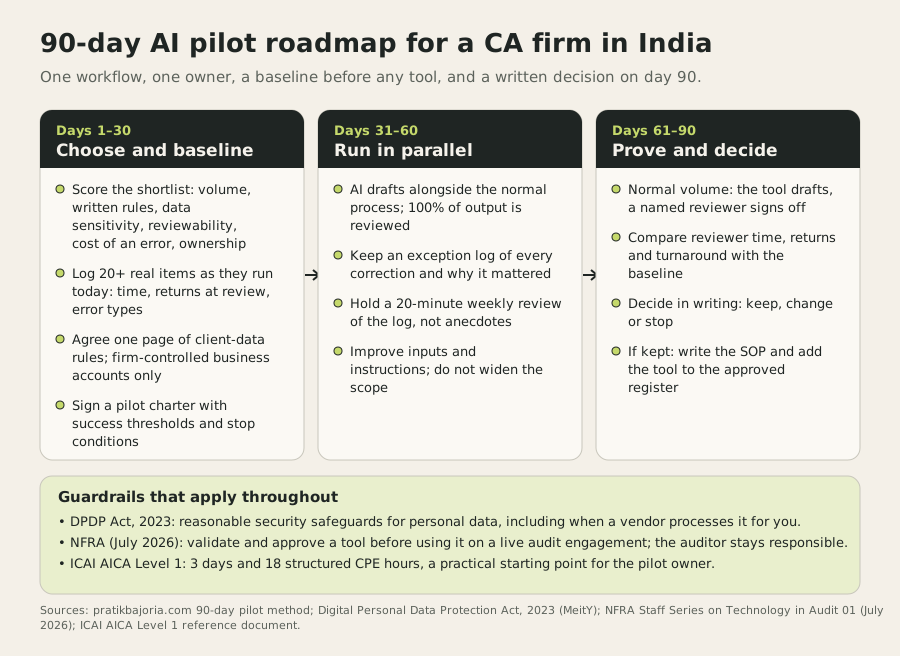
Text version of this infographic
- Days 1–30, choose and baseline: score the shortlist on volume, written rules, data sensitivity, reviewability, cost of an error and ownership; log at least 20 real items as they run today; agree one page of client-data rules using firm-controlled business accounts only; sign a pilot charter with success thresholds and stop conditions.
- Days 31–60, run in parallel: AI drafts alongside the normal process and 100% of output is reviewed; keep an exception log; hold a 20-minute weekly review of the log; improve inputs and instructions without widening scope.
- Days 61–90, prove and decide: run at normal volume with a named reviewer signing off; compare reviewer time, returns and turnaround with the baseline; decide in writing to keep, change or stop; if kept, write the SOP and add the tool to the approved register.
- Guardrails: the DPDP Act, 2023 requires reasonable security safeguards for personal data, including when a vendor processes it; NFRA’s July 2026 paper expects tools to be validated and approved before use on a live audit engagement; ICAI’s AICA Level 1 is 3 days and 18 structured CPE hours.
Days 1–30: choose the workflow, take the baseline, set the rules
Pick the first workflow on evidence, not excitement
Good first candidates are frequent, repetitive and easy to check. In a typical practice that might be first-pass categorisation of bank statement lines for bookkeeping clients, drafting routine document-request emails, summarising long agreements or departmental notices so a reviewer knows where to look, preparing exception lists for GST reconciliation, or turning a new circular into an internal checklist. Poor first candidates are anything that ends in a professional opinion, a signed report, tax-position advice or a filing that could leave the firm without a person reading it.
Score your shortlist against the criteria below, 1 to 5 each, and pick the highest total rather than the most interesting idea.
| Criterion | Score high (5) when | Score low (1) when |
|---|---|---|
| Volume | It happens every week across many clients | It happens a few times a year |
| Rules | The steps are written down, or could be in an afternoon | It depends on one senior’s judgement |
| Data sensitivity | It works on redacted or low-sensitivity data | It needs identity numbers, payroll or unpublished results |
| Reviewability | A reviewer can check output against the source quickly | Checking takes as long as doing it |
| Cost of an error | Mistakes are caught inside the firm | Mistakes reach a client, a department or a filing |
| Ownership | A manager wants it fixed and will run the pilot | It is nobody’s job |
Take the baseline before anyone touches a tool
Without a baseline, the day-90 conversation is a contest of opinions. For two or three weeks, have the owner log the chosen workflow as it runs today: how many items were processed, roughly how long each took, how many came back from review, and what kind of errors the reviewer caught. Rough is fine. An honest log of twenty real items beats a confident estimate.
Write the client-data rules on one page
Your confidentiality obligations under ICAI’s framework do not pause for a pilot, and where the material includes personal data, the Digital Personal Data Protection Act, 2023 expects reasonable security safeguards, including when a vendor processes that data for you. Before the pilot starts, partners should agree, in writing:
- which kinds of data may go into the tool, and which never may;
- that only a firm-controlled business account is used, never a personal one;
- who administers retention and access, and what the settings are;
- where outputs are saved: the engagement file, not a chat history;
- whether engagement letters or client communications need updating, on which you should take proper advice.
The fuller version is in the AI controls checklist for CA firms in India. For a pilot, one page people actually read beats a policy nobody opens.
Sign a one-page pilot charter
The charter names the workflow, owner, reviewer, tool, data rules, baseline, success measures, stop conditions and decision date. Set the success measures before you begin, in terms you already track or can log: reviewer time per item, items returned at review, turnaround from receipt to completion, and any breach of the data rules. Agree the thresholds in advance. If the partners only decide what “good” means after seeing the results, the pilot will always succeed on paper.
Days 31–60: run it in parallel, with a review gate on everything
In the second month the AI-assisted version runs alongside the normal process. Either the team does a sample both ways, or the tool drafts and a reviewer checks every single output. Review is 100% in this phase, with no exceptions for items that look fine.
Keep an exception log. Every time the reviewer corrects something, record what was wrong, why it mattered and how serious it was. Then hold a twenty-minute weekly review with the owner, the reviewer and the sponsoring partner, and look at the log rather than anecdotes. Use what you learn to improve the inputs, templates and instructions. Do not widen the scope; a pilot that grows every week cannot be measured.
Watch for three things: staff drifting outside the data rules because it is quicker, outputs that read well but cite the wrong section or figure, and preparation time saved being eaten by longer review. Only the log will show the last one.
Days 61–90: prove it at normal volume, then decide
In the final month the tool drafts and a named person reviews and signs off, at normal volume and ideally through at least one stretch of real deadline pressure. A workflow that only works in a quiet week will not survive filing season. If, and only if, the exception log supports it, you can move internal-only items from full review to risk-based sampling. Anything that leaves the firm keeps full review.
At the end, compare the pilot against the baseline and write a short decision memo. There are only three honest outcomes.
| Decision | When it applies | What happens next |
|---|---|---|
| Go | Measures met, no unresolved control issues, and the team uses it without being chased | Write the procedure, train the next team, add it to the firm’s AI register |
| Adjust | Some value, but review effort is high or errors cluster in one step | Narrow the scope or fix the inputs, then rerun for 30 days on the same measures |
| Stop | No measurable improvement, or a confidentiality or quality risk you cannot control | Record why, release any single-purpose licences, and pick the next candidate |
Stopping is a legitimate result. A practice that can show partners why it stopped one pilot will find it much easier to fund the next one. I have written more about that in when a finance team should say no to an AI pilot.
Plan around the compliance calendar
Indian practices have predictable crunch periods around return and audit due dates. Do not start the parallel run in the fortnight before a major deadline, because review is the first thing that gets squeezed. But make sure the final month includes some real load: the aim is to prove the workflow in an ordinary busy period, not to hide it from one.
Mistakes I see most often
- Piloting the tool instead of the workflow. “Let’s try Copilot” is not a pilot. “Let’s cut reviewer time on bank categorisation for bookkeeping clients” is. If the tool itself is still undecided, settle that first; see how a CA firm in India should choose an AI assistant.
- No baseline. Without one, every result is anecdotal.
- Scope creep. Adding a second workflow in week five resets the measurement.
- No owner for the decision date. Pilots without a fixed end quietly become unmanaged production.
For the wider implementation map, start at the AI for chartered accountants in India hub. If GST is your likely first workflow, read using AI for GST reconciliation without risking client data. For help scoping the first pilot, take the free AI Opportunity Scorecard, look at the AI Opportunity Audit, or book a discovery call.
Pilot-ready checklist
- One workflow named, with an owner and a reviewer.
- Selection scores recorded for every shortlisted workflow.
- Two to three weeks of baseline logged on real items.
- One-page client-data rules agreed by the partners.
- Firm-controlled business account set up, with retention configured.
- Charter signed, with success measures, thresholds and stop conditions.
- Exception log template ready before day 31.
- Weekly twenty-minute review in the calendar.
- Decision date fixed, and kept clear of the heaviest filing weeks.
Frequently asked questions
How long should an AI pilot in a CA firm take?
Ninety days is a practical default for one workflow: a month to choose it, take a baseline and agree data rules, a month running AI in parallel with full review, and a month at normal volume before a written go, adjust or stop decision.
What is a good first AI use case for a CA practice in India?
Pick something frequent, repetitive and easy to check, where mistakes are caught inside the firm: for example first-pass bank statement categorisation, routine document-request emails, summaries of long notices for a reviewer, or GST reconciliation exception lists. Avoid anything that ends in an opinion, a signed report or a filing.
Do we need client consent to use AI on client work?
It depends on your engagement terms, the data involved and your obligations under ICAI’s framework and the Digital Personal Data Protection Act, 2023. Take proper advice on your facts. Many firms start the pilot on redacted or internal-only data, which keeps the question manageable while they learn.
What if the pilot does not work?
Stopping with evidence is a valid result. Record why, release any single-purpose licences and move to the next candidate. A clear record of why one pilot stopped makes the next one easier to approve.
Sources
- Digital Personal Data Protection Act, 2023 (Gazette text, MeitY)
- NIST AI Risk Management Framework
- NIST AI 600-1 — Generative AI Profile
Disclaimer: this article is general educational commentary from implementation work. It is not legal, tax, audit, data-protection or procurement advice, and it does not create an adviser–client relationship. Tool terms and features change; read the current terms for your plan and take professional advice on your specific facts before acting.