Ecommerce accounting becomes difficult when order data, payment settlements, refunds, fees, inventory and tax records live in separate systems. Start with the operating constraint, then compare tools against the workflow rather than choosing from a generic “best software” list. The goal of automation is a reliable chain from sale to settlement to ledger to management report — not a dashboard that looks tidy while reconciling items age quietly.
For the finance leadership sequence behind that decision, see the 90-day AI finance automation roadmap for CFOs and controllers. It covers baseline design, control gates, pilot measurement and the evidence required before scaling.
Map the settlement cycle for every channel. Identify the source of truth for orders, payments, fees, refunds, chargebacks, shipping and inventory. Then define which entries may be automated and which exceptions require review. Synder is worth evaluating when commerce and accounting systems need synchronisation. Test mapping rules, settlement timing, duplicate prevention, exception handling, audit trail and exportability. Notion can hold the close checklist and issue log, but it should not replace the accounting system of record.
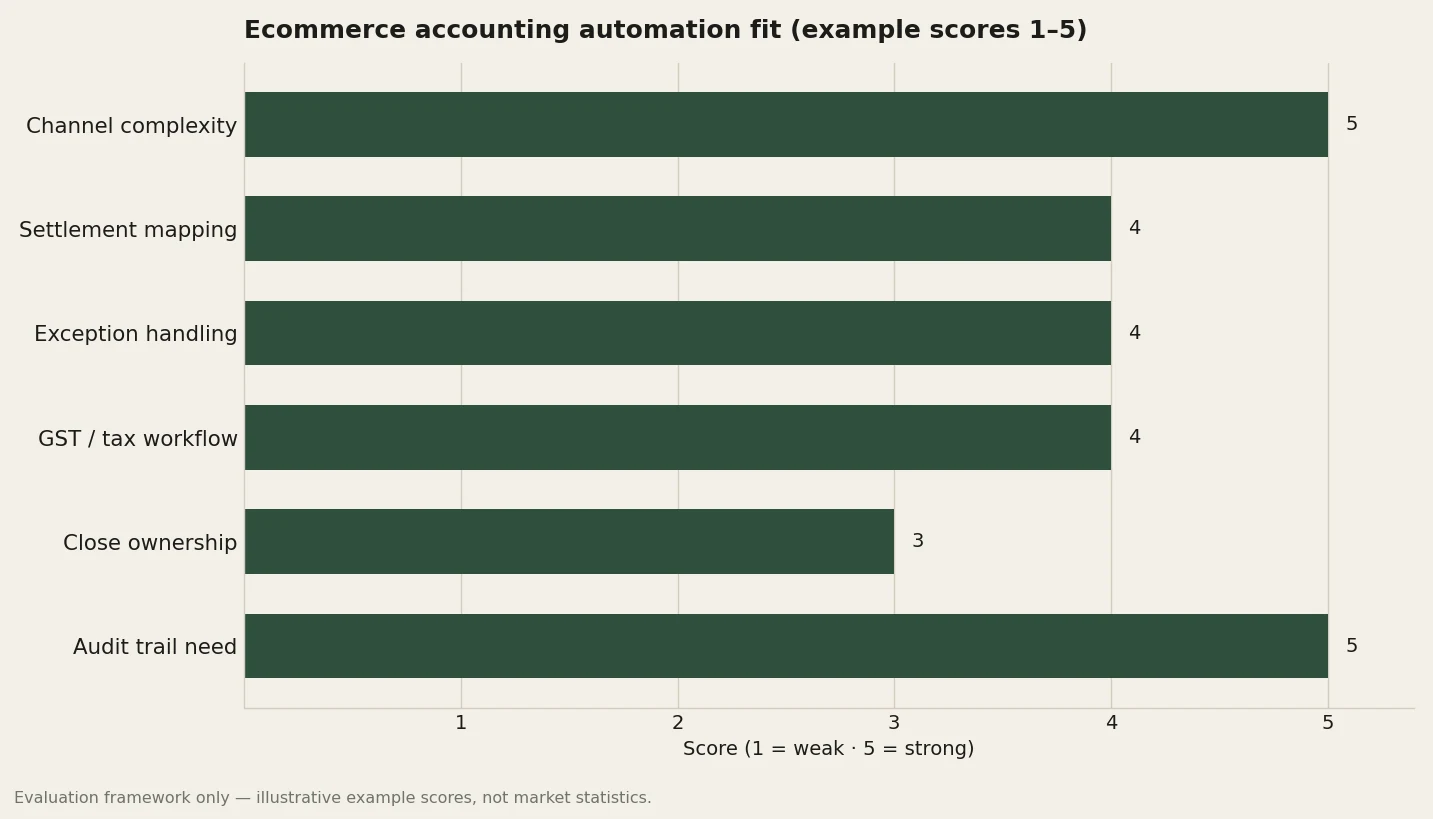
Decision rubric (score 1–5 yourself)
Score each row before buying connectors or expanding automation. Under about 18: stabilise process and ownership first. Above about 22 with a named close owner: run a controlled parallel pilot.
| Axis | 1 = weak fit | 5 = strong fit | Your score |
|---|---|---|---|
| Channel complexity | Single simple storefront | Multiple marketplaces, gateways and currencies | ___ |
| Settlement mapping | You cannot explain fees and timing | Clear map from sale to settlement to ledger | ___ |
| Exception handling | Exceptions pile up unread | Named owner, ageing list, weekly clear-down | ___ |
| GST / tax workflow | Tax treated as an afterthought | Credits, returns and filings supported by evidence | ___ |
| Close ownership | Month-end is tribal knowledge | Documented close checklist with deadlines | ___ |
| Audit trail need | Edits without history | Traceable changes, exports and reconciliations | ___ |
What “good” looks like in operating terms
Good automation does not mean zero human touch. It means routine matches post cleanly, exceptions are visible early, and month-end does not depend on heroic spreadsheet reconstruction. Write the control points explicitly: who approves unusual refunds, who investigates gateway fee mismatches, who signs off inventory adjustments, and which reports management trusts for cash and margin decisions.
For India-based operators, test GST treatment, marketplace deductions, returns and credit notes, TCS where applicable, and reporting needs. Product capability does not automatically equal compliance. The business remains responsible for records and filings. Confirm local requirements with your advisor; software configuration is not a substitute for professional judgement.
Monday-morning checklist
- Refresh the channel map: storefronts, marketplaces, gateways, banks and ledger entities.
- Age the exception list: duplicates, unmatched settlements, returns without credit notes.
- Confirm who owns close tasks this week and what evidence they need.
- Spot-check one settlement batch from payment report to ledger entry.
- Log one mapping or checklist fix — then stop expanding automation until exceptions shrink.
Pilot design a CA would accept
Run the connector in parallel for a defined period without abandoning the existing reconciliation discipline. Compare automated entries to known settlement reports. Track exception volume, time to clear exceptions, and whether management reports still reconcile to bank and marketplace statements. Only then widen automation to more channels.
Document mapping decisions as operating assets: which SKU fields matter, how fees are classified, how refunds create credit notes, and how inventory adjustments are evidenced. Those artefacts make the next marketplace onboarding cheaper and reduce key-person risk when the original implementer moves on.
Common failure modes
Automating before the settlement cycle is understood. Treating marketplace payouts as “sales” without fee and return detail. Letting exceptions age past close. Using Notion or chat as the ledger. Declaring victory because the dashboard is green while cash and GST evidence remain messy. Avoidance is operational: map first, parallel pilot second, expand third.
What this guide is not
This article is educational and does not constitute tax, accounting or legal advice. Confirm local requirements with your advisor and verify current pricing, integrations and data handling on vendor official sites before purchase.
How to review progress after four weeks
At the end of a controlled trial, write a one-page note a sceptical finance partner can read. Cover what you attempted, what evidence you produced, what changed in operating behaviour, and whether the tool should be renewed, downgraded or cancelled. Prefer concrete artefacts — decision logs, exception lists, shipped actions — over vanity dashboards. If you cannot produce that note, the experiment is incomplete regardless of how impressive demos looked.
Carry forward only the workflows with a named owner and a metric you already manage. Archive unused seats and unused tracking lists. Tool sprawl is a quiet tax on attention; a shorter stack with weekly discipline usually beats a broad stack that nobody operates.
How to review progress after four weeks
At the end of a controlled trial, write a one-page note a sceptical finance partner can read. Cover what you attempted, what evidence you produced, what changed in operating behaviour, and whether the tool or workflow should be renewed, narrowed or cancelled. Prefer concrete artefacts — decision logs, exception lists, shipped actions — over vanity dashboards. If you cannot produce that note, the experiment is incomplete regardless of how impressive demos looked.
Carry forward only the workflows with a named owner and a metric you already manage. Archive unused seats, unused templates and unused tracking lists. Tool sprawl is a quiet tax on attention; a shorter stack with weekly discipline usually beats a broad stack that nobody operates.
What changes for an Indian D2C or marketplace seller
Most software comparisons are written for US or UK sellers. In India, three things make ecommerce books harder, and any tool you shortlist should handle them without a spreadsheet on the side.
GST TCS on marketplace sales. Marketplaces collect tax at source under section 52 of the CGST Act. Notification 15/2024-Central Tax cut the rate from 1% to 0.5% (0.25% CGST plus 0.25% SGST, or 0.5% IGST) with effect from 10 July 2024. The operator reports it, and it appears in your electronic cash ledger only after you accept it. Your tool should reconcile each marketplace’s TCS to the sales it booked, by month and by state.
Settlement reports, not invoices, drive the books. A single marketplace payout nets sales, commissions, shipping, fees, returns, TCS and sometimes TDS. Good automation explodes that payout into its parts and matches it to orders. Weak automation posts the net amount as revenue, which is exactly what a CA will unpick at year end.
E-invoicing and returns. If your aggregate turnover is above ₹5 crore, e-invoicing has applied since 1 August 2023. Returns then need credit notes that match the original IRN. Ask every vendor to show a return flowing through to a credit note and a GSTR-1 line, not just a sale.
| Check | What good looks like | Red flag |
|---|---|---|
| Settlement split | Each payout broken into sales, fees, returns, TCS and TDS, matched to orders | Net payout posted as revenue |
| GST TCS | Marketplace TCS reconciled to booked sales by month and state | TCS left for the CA to find at return time |
| Returns | Credit notes linked to the original invoice | Returns netted off sales with no document |
| Books | Posts to Zoho Books or TallyPrime with an audit trail | A parallel ledger nobody reconciles |
For the reconciliation side in more depth, read where ecommerce reconciliation automation helps and where it lies and the GSTR-2B reconciliation method.
Frequently asked questions
What is the GST TCS rate for ecommerce sellers in India?
Since 10 July 2024 marketplaces collect TCS at 0.5% of net taxable supplies (0.25% CGST plus 0.25% SGST, or 0.5% IGST), under Notification 15/2024-Central Tax. It was 1% before that.
Do D2C brands need e-invoicing?
Businesses with aggregate turnover above ₹5 crore have had to issue e-invoices for B2B supplies from 1 August 2023. Check your own turnover and supply types with your CA.
What is the best accounting automation software for ecommerce?
There is no universal winner. The best fit is the platform that connects your actual order and settlement sources to the ledger, prevents duplicate postings, makes exceptions visible and preserves evidence for review. Start with your channels and close process, not a vendor ranking.
How do you automate ecommerce accounting?
Map orders, payouts, fees, refunds, chargebacks, inventory and tax data. Automate stable mapping and matching rules, then keep a human review gate for exceptions, unusual settlements and period-end sign-off.
What should I check before buying ecommerce accounting software?
Check channel coverage, settlement timing, duplicate prevention, returns and inventory handling, GST or tax reporting, permissions, audit-trail export, retention terms and whether the vendor can support your exception workflow.
Which accounting software offers the best automated reporting features for e-commerce businesses?
The best fit is the product that reports from your actual order, payout, fee, refund and ledger data with clear mappings and visible exceptions. Compare report coverage, refresh timing, exportability, permissions and evidence instead of relying on a generic ranking.
What features should I look for in an ecommerce accounting automation tool?
Look for channel and settlement coverage, duplicate prevention, returns and inventory handling, GST or tax support, exception queues, role-based permissions, audit-trail export, retention controls and a named support path.